
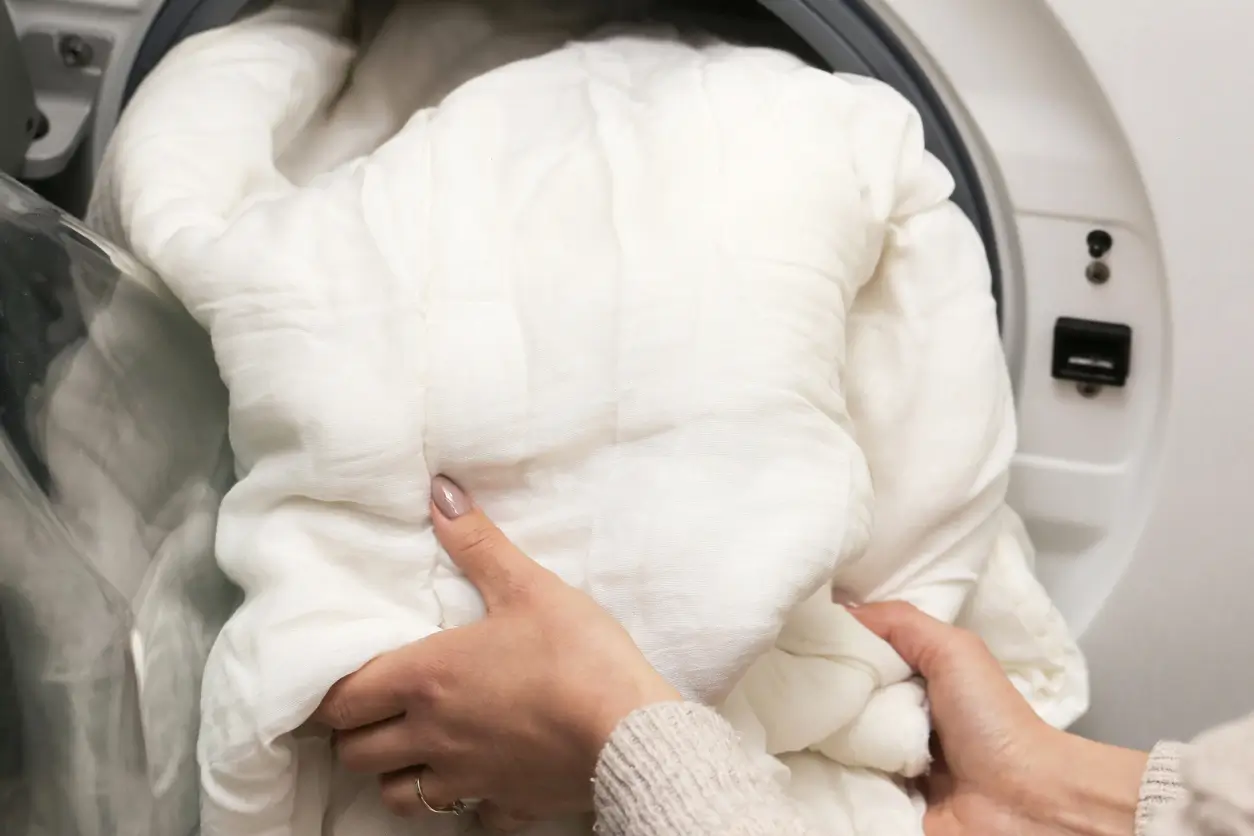
How to Keep Comforters From Shrinking, Flattening, or Clumping in the Wash
Your washer was never built for this. Most home machines are designed for shirts, towels, and bed sheets, not a queen- or king-sized comforter that can weigh several times more once it's soaked through. Shrinking affects the shell. Flattening affects the fill. Clumping happens somewhere in between, when the fill shifts during the wash and never redistributes.
Three different problems, three different causes, and, most of the time, three completely avoidable mistakes. Here's what actually happens at each of those three stages and the specific fix for each of them.
Shrinkage Starts With the Shell, Not Just the Fill
Hot water shrinks cotton fibers. High dryer heat shrinks them again. That's the shell, not the fill. Down and synthetic fill don't contract the same way, but once the shell around them tightens, your whole comforter ends up feeling a size smaller, even though the actual insulation inside hasn't changed at all.
Cramming it into an undersized drum makes things worse. It drags against the same spot on the drum wall every rotation, and that friction wears down the fabric a little more with each wash, compounding the shrinkage heat alone was already causing.
The Water Temperature and Drum Size That Prevent It
- Stick to cold or warm water. Skip hot unless the comforter is visibly soiled, since heat is the main reason shells shrink in the first place.
- Use a front load washer or a high capacity top loader without a center agitator, so the comforter has room to move.
- A laundromat's oversized washer beats forcing a comforter into a machine that's too small for it.
Run a quick check before you start: if the dry comforter fills more than half the drum, you have the wrong machine, not the wrong cycle.
Flattening Happens When the Fill Loses Its Loft Permanently
Wet fill compresses under its own weight the moment it's saturated. Down clusters collapse. Synthetic fibers mat flat. None of that is permanent by itself, but drying decides whether it stays that way. Dry the fill while it's still compressed, and the heat locks it into that flat shape for good, which is why the drying step matters just as much as the wash cycle that comes before it.
Why Dryer Balls Aren't Optional for Down or Synthetic Fill
- Toss in two or three wool or rubber dryer balls, or clean tennis balls. They knock apart clumps as the load tumbles and work air back into the fill.
- Choose low or medium heat over a longer cycle instead of high heat over a short cycle. It takes longer to dry the core this way, but the fill keeps its shape.
- Stop the dryer once or twice partway through, and fluff the comforter by hand, focusing on any spot that feels denser than the rest.
You'll know it works when the comforter feels evenly puffy edge to edge, with no flat seams and no hard spots in the middle.
Clumping Happens When the Fill Migrates and Won't Redistribute
A rough wash cycle pushes loose fill toward one corner or seam. Once it bunches there, tumbling alone won't spread it back out. Leftover detergent makes it worse, since the residue acts almost like glue and binds fibers together right where they clumped.
Letting a wet comforter sit before it goes into the dryer adds a second problem. Fill keeps settling the longer it stays wet, and a damp comforter left balled up in the washer is exactly how a musty smell gets started – and it’s sometimes days before anyone notices it.
The Correct Home Washing Method for Most Cotton and Polyester Comforters
Most cotton and polyester comforters handle a home comforter cleaning just fine when you follow this order:
- Check that the comforter has room to tumble freely. If it's packed in tight, move to a bigger machine.
- Run a gentle or delicate cycle with cold or warm water only.
- Use a small amount of liquid detergent. Skip powder, since it can leave residue trapped in the fill.
- Add a second rinse cycle to flush out anything left behind.
- Move the comforter to the dryer immediately. Don't let it sit wet, even briefly.
- Dry on low to medium heat with two or three dryer balls or clean tennis balls.
- Pause the cycle once or twice, and pull apart any matted sections by hand.
- Check the center seam before folding it away. That's where moisture lingers longest.
The Comforters Home Washing Can't Handle
Some comforters aren't built for a home wash, no matter how closely you follow the steps above. The construction sets the limit, not your technique, and no amount of careful handling changes what the materials themselves can actually tolerate.
Down, Silk, Wool, and Heavily Embellished or Quilted Fills
- High fill power down: needs steady, high volume airflow to dry all the way through. A home dryer often leaves the center damp while the outside feels done, and that sets up mildew days later.
- Silk shells: snag and shred under a washer's agitation, even on the gentlest setting available.
- Wool comforters: felt and shrink the moment they're agitated. Unlike a wool sweater, there's no reshaping them afterward.
- Heavily quilted or embellished pieces: risk pulled stitching, torn trim, or buttons and ties caught in the drum during a normal cycle.
A “dry clean only” label sometimes exists just to limit liability. For these materials, though, it usually points to a real limit in what the piece can survive. A dry cleaning process built for delicate fibers protects them the way a home machine can't.
How to Rescue a Comforter That's Already Flat, Matted, or Clumpy
A flat comforter isn't automatically done for. Commercial capacity machines can balance the load correctly and rinse out the residue holding clumps together, and refluffing afterward often restores loft to fill what's simply displaced rather than actually damaged.
Fill that's broken down is a different story. No amount of cleaning brings back fiber structure once it's degraded rather than just shifted out of place.
Pull apart the flattest section with your hands. If it puffs back up, even briefly, cleaning can likely reset it. If it stays flat or feels crumbly, replacement makes more sense than repair.
Why Machine Size Matters More Than Any Other Setting
Most home washers under about 4.5 cubic feet can't properly agitate a queen or king comforter, and that limitation outweighs any setting you choose. An undersized machine doesn't allow the comforter to move enough to wash or rinse evenly, regardless of temperature or cycle.
That's the exact gap a bedding cleaning service closes: equipment sized for the load, instead of a home machine working past its limit no matter how carefully every other step is followed.
Why Your Comforter Is Better Sent to a Professional Cleaner Instead
If your comforter falls into the down, silk, wool, or oversized category above, home washing risks doing more harm than good. A professional Comforter Cleaning Service uses fabric-specific cleaning methods and controlled drying to help preserve loft, shape, and softness while removing the dirt, oils, and allergens home machines often leave behind.
For Comforters Your Home Washer Can't Handle, Trust Liberty Dry Cleaners
Liberty Dry Cleaners offers a full Comforter Cleaning Service for Kennett Square and Glen Mills, Pennsylvania area customers for down, silk, wool, or oversized comforters home machines can't properly wash or dry.
If you're searching for a Comforter Cleaning Service in Kennett Square or Glen Mills, schedule a FREE Pickup and Delivery Service or drop off your comforter, and our team will recommend the safest cleaning method for your specific bedding before any cleaning starts.
Email: info@libertydrycleaners.net
Kennett Square: 120 Onix Drive, Kennett Square, Pennsylvania, 19348
Phone: +1 610-925-3478
Concordville / Glen Mills: 301 Byers Drive, Suite 1, Glen Mills, Pennsylvania, 19342
Phone: +1 610-358-3076